
Backend Architecture
Overview
The Scientific Data Layer (SDL) backend implements a Linked Data Platform (LDP) that supports modular, scalable scientific data management across a system-of-systems (SoS) architecture. The platform is built on microservices that interoperate through well-defined RDF-based interfaces, allowing distributed deployment, semantic integration, and extensibility.
The architecture is designed with three layers of abstraction:
- Layer 1: Storage Abstractions
- Layer 2: Core Services
- Layer 3: Domain Services
Each layer encapsulates distinct responsibilities, promoting separation of concerns and clean layering for service orchestration and reuse.
Linked Data Platform (LDP) in SDL
The SDL adopts the W3C Linked Data Platform standard, enabling resources to be accessed and managed using HTTP operations with RDF content negotiation. Key features include:
- Support for LDP Containers (Basic, Direct, and Indirect)
- Full RDF serialization support (Turtle, JSON-LD, RDF/XML)
- Content negotiation and pagination
- Membership triple management
- LDP preference headers (Prefer/Include/Omit)
Benefits of LDP for SDL
- Interoperability with existing semantic web infrastructure
- Seamless integration of new data sources and services
- Federated architecture via HTTP-based interfaces
- Modular handling of RDF-based resources with type-specific routing
Layer 1: Storage Abstractions
This layer provides unified access to diverse storage backends:
- Triple Stores: e.g., Blazegraph, GraphDB (for RDF graphs)
- Object Storage: e.g., MinIO, S3 (for binary files and media)
- File System: Local or network-based hierarchical file access
- Databases: SQL (e.g., PostgreSQL) and NoSQL (e.g., MongoDB)
Key Components
StorageService: Main service interfacing with storage adaptersStorageAdapters: Plug-ins for specific storage technologiesGraphStore,FileStore,ObjectStore,DocumentStore: Abstractions over common types of data
Layer 2: Core Services
These services interact directly with Layer 1 abstractions to offer higher-order functionality.
Registry Service
- Manages identity and metadata of resources
- Assigns persistent URIs
- Interfaces with
GraphStoreto maintain system metadata
Data Transfer Service
- Coordinates the movement of raw and processed data
- Supports streaming, batch uploads, and ingestion workflows
- Interfaces with
ObjectStoreandFileStore
These services form the operational and orchestration backbone of the SDL.
Layer 3: Domain Services
These services build on core services to provide domain-specific, user-facing functionality. They aggregate, manage, and expose scientific content in semantically meaningful ways.
Catalog Service
- Exposes dcat:Catalog, dcat:Dataset, and dcat:Distribution
- Organizes datasets into hierarchical, discoverable catalogs
- Uses LDP containers for dataset navigation
Repository Service
- Manages experimental and observational data repositories
- Supports SSN/SOSA ontologies and scientific workflows
Workspace Service
- Implements collaborative workspaces akin to Notion
- Manages doco:Document, spar:Project, and sdlo:Page resources
- Utilizes ProseMirror and DoCO alignment for editable block content
Inter-Service Relationships
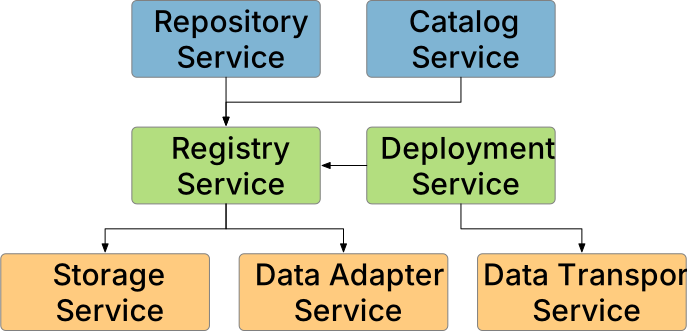
Layer 3 services depend on the Registry and Data Transfer services for URI management, metadata registration, and data ingestion. These, in turn, use the Storage layer for physical storage and retrieval.
Microservice Overview
All SDL services are implemented as FastAPI-based Python microservices. FastAPI is chosen for its:
- Excellent support for async I/O and performance
- Built-in OpenAPI (Swagger) documentation
- Pydantic-powered data validation
- Clean developer experience for REST+RDF hybrid APIs
Each service includes:
- Linked Data support (via RDFLib and rdflib-jsonld)
- LDP resource routing (Basic/Direct/Indirect containers)
- SPARQL endpoint access (where applicable)
- Dependency-injected stores and utilities
- OpenAPI spec auto-generation for documentation and testing
Service Breakdown
Storage Service (Layer 1)
- Exposes storage adapters for graph, object, document, and file storage
- Provides a consistent internal interface to all persistence layers
Registry Service (Layer 2)
- Assigns persistent URIs to all resources
- Tracks resource metadata in named RDF graphs
- Ensures namespace scoping across platforms and subsystems
Data Transfer Service (Layer 2)
- Handles ingest, upload, and movement of data blobs
- Supports streaming APIs and batch upload endpoints
Repository Service (Layer 3)
- Hosts scientific datasets, experiments, and observations
- Aligns data with SSN/SOSA ontologies and workflows
Catalog Service (Layer 3)
- Organizes datasets using DCAT v3
- Exposes discovery APIs and RDF views of datasets and catalogs
Workspace Service (Layer 3)
- Provides collaborative document editing capabilities
- Supports semantic block types via DoCO and ProseMirror
- Manages multi-user workspaces and document hierarchies
All services use standardized middleware for:
- Logging and monitoring
- Authentication and authorization (RBAC)
- Linked Data serialization and content negotiation
Advantages of the Architecture
- Modularity: Each service is independently deployable
- Extensibility: New services can be added at any layer
- Scalability: Storage and compute can scale separately
- Interoperability: LDP and RDF interfaces ensure compatibility with semantic web tools
- Reusability: Abstractions can be reused across domains and workflows
This structured backend enables SDL to manage scientific data in a FAIR, modular, and linked fashion, adaptable to complex research ecosystems and evolving data governance needs.